

Skunked
My dog made a choice. Plus a life update, and a writing update.

It was a great day until about 10:45 PM.
Another crisp, cool September night on the water. Quiet but for the sound of waves crashing, wind in the leaves, and the giant muffling of surrounding forest. I was thinking about the essay I was writing, about what tomorrow’s schedule would look like, about —
WOOF
Then, silence.
I called him back. Nothing. Then I called him back (with desperation.)
TEXAS. COME.
More silence.
Then, the rapid jangling of a collar as he booked it from somewhere in the darkness back to the cottage.
Once he reached the footprint of the white floodlight I saw it: his mouth covered in a foamy drool. Ears back. Tail between legs. The milliseconds passed in slow motion. And then the smell, impossible to miss. Unmistakable.
GOD DAMNIT I yelled into the forest and then MOTHER FUCKER for good measure, and then both of these, on and off, for the next minute.
My edible had just started to kick in. I was preparing myself for bed not 30 seconds before, just completing the last step of the routine - letting the dog out to pee.
If your dog has never been sprayed by a skunk, just know that there is a before and an after. Before skunk, B.S, where the world appears manageable and smells are temporary; and a distinct After, an A.D.; when you wish you were dead. When your naïveté about how much damage one small, monochrome squirrel can do — how easily it can disrupt your every waking and sleeping moment — is dust in the wind.
I called my friend whose dog was skunked twice last year. Asked,
What do I even do?
I actually have the perfect solution, she said. You take a gun, and you shoot yourself.
This is only a minor exaggeration for correcting such an issue.
Being skunked rearranges your life in the blink of an eye. Forget your plans. Forget your priorities. Your assumption that you’ll get some sleep tonight. Your belief that tomorrow’s itinerary will proceed as you anticipated.
Your new priority is: keep the smell away.
Your new to-do list is: go buy exorbitant amounts of tomato juice and hydrogen peroxide and baking soda; give your dog three baths; keep him away from anything of value.
Do you enjoy sharing time and space with your beloved, loyal furry friend? Not anymore! Get that guy away from you and anything you don’t want to smell like Skunk for the rest of time.
If it wasn’t bad enough to have the scent of torched onions in your home, so pungent you gag, you’ll also have the distinct pleasure of shepherding your dog through their own traumatic experience of being pepper sprayed in the nostrils. Try not to hate yourself when they look at you with the saddest eyes you’ve ever seen and whimper, Why are you punishing me like this?
Thankfully the nonstop lake breeze quickly blew away the scene of the crime, and a screened-in porch offered a place of refuge for my stupid idiot sweet angel baby to sleep for the night, though of course, he didn’t sleep. No. He whined and barked all night to come inside. Which means I didn’t sleep. Which means today I am a cranky bitch, ready to burn this place down to the studs. Then take a long nap.
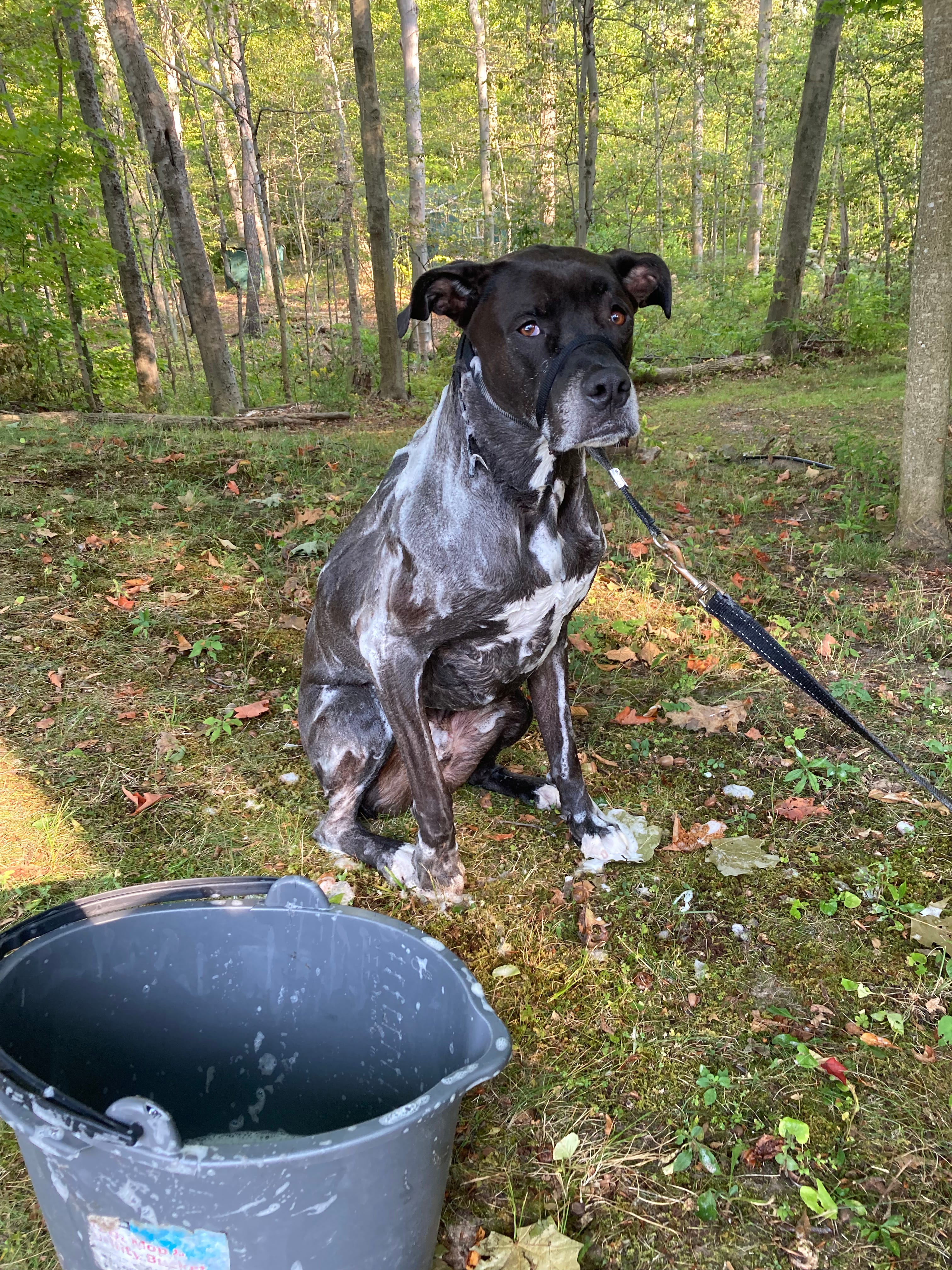
There is one (1) nice part of having your dog sprayed by a skunk, and it is this: it brings you right back down to Earth, right back to humility, right back to the wisdom and the certainty that there are some times in this life you are forced to wait.
Some things only Time has the power to heal.
I felt this way years ago when Texas was neutered, and was forced to stay on bedrest and in a cone for a week. In this situation, it feels like you are playing God. Your dog is on a timeline of torture only accessible to you. You can’t tell them, Hey buddy, only four more days.
You know how long this will last. They don’t.
You know this will end and things will be back to normal. They don’t.
For all they know, this is forever. From now on, life will be lived from the inside of a plastic cone. No more peripheral vision. No more licking your butt.
From now on, hydrogen peroxide-baking soda baths will be required three times a day and you’ll never again lay on a soft, carpeted surface.
The Universe or God or whoever is running this place has played that game with me, too — with all of us — in one way or another.
How long will I be single? When will I get a job? How long am I going to be heartbroken? When the hell are we going to finally board this plane?
It’s nice to imagine there’s someone up there, an adult who knows the schedule of this torment. They know the timeline, I don’t. They couldn’t communicate it to me even if they wanted to. It’s a temporary stint, no matter how long it feels; how hopeless it makes me. I just don’t know how long I’m in my cone for. I just don’t know how long the skunk fumes will linger.
The irony is that I have been thinking and writing and editing and writing some more — for two months — about transitions. About how to navigate the unknown. About what the natural world teaches us about liminal spaces, where we’re somewhere unfamiliar and foreign, and there for an indeterminate amount of time.
I was thinking, constantly, about how we remain connected to our instincts, our animal selves, during experiences which require us to be in The Unknown for an amount of time we have no control over.
And then, I was plunged into a new kind of forced surrender: when a skunk sprays your dog, there is very little you can do to correct that situation quickly. Or, on any type of predictable timeline. You are thrown into a liminal space; unknown territory, where you are out of control of the duration of your stay. You’re not in charge of this situation. Neither is your dog. Neither is a vet or a friend or an expert or someone on Reddit. Who’s in charge of this situation is no one, except possibly the skunk, whose control is a past-tense verb and who, at this point, is long gone.
And so all there is left to do is make it through.
There is a lot to say about transition, about liminality, about approaching it from the perspective of an ecologist, a biologist, a scientist. About approaching it with curiosity rather than contempt, rather than fear.
I’m working on a three part series for this topic, and plan to share it starting next month.
But I first want to share some context for this fascination, and an update on both this newsletter and the particular stage of life I find myself in.
A Life Update
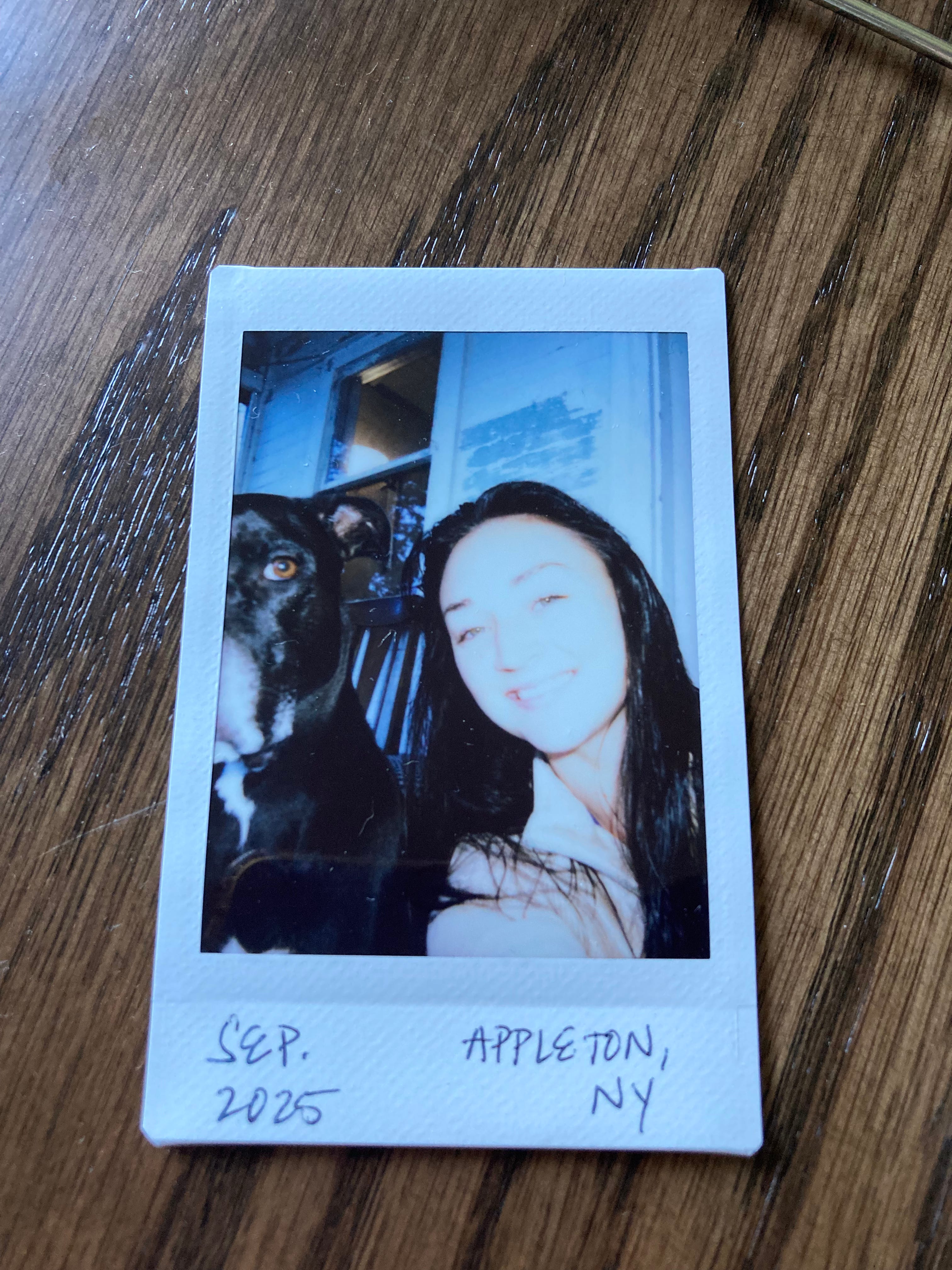
In late August, I packed up my apartment, put everything into storage, and left Denver with my car, some suitcases, and my dog.
This month, we’ve been living at a family cottage on Lake Ontario with no cell service, no wifi, various furry and eight-legged roommates, and, evidently, a neighboring skunk. Next month, I’ll be in Chicago. Then, a litany of other places where friends and family are housing us during my six-month self-created sabbatical before returning to the ranch and to Colorado. If all goes to plan, I’ll be abroad for a few months. It should be a pretty cool six months, honestly, although this was absolutely not my plan for the year and was actually instead my last resort— brought to life after so many critical things fell through and apart with an efficiency so sweeping and immediate one might think it was predestined. At the very least, voted for unanimously by the Powers That Be. For context:
After three months of interviews, I was offered a full time job in my particular niche of corporate sustainability, then a few weeks later was told the role was, on second thought, not actually approved by corporate in the first place. The lease on my apartment was coming up, and rent was going up. The farming season was petering out. And my relationship ended abruptly.
So many doors shut, so fast, my hair was blowing in the wind of their slamming closed. No set place to live, so set job to do, no set person to make out with — calls for a road trip. Calls for some “hey, any chance I could live with you for free for a few weeks?” text messages to be sent out. Calls for some big-picture questioning: maybe this sudden expanse of uncertainty is an opportunity to try something new? Maybe being booted so egregiously out of my comfort zones shouldn’t be ignored.
It all came after what was already a pretty tumultuous year, of leaving my full-time sustainability career in favor of self-employment, part-time consulting work, and being a ranch-hand. Of rethinking what I actually want to do with my days. Of redesigning my schedule, my weeks, from a clean slate. Of forgetting the default lifestyle and making my own from scratch.
I have a lot to say about my decision to depart from the world of Corporate Sustainability. About what the implications of working in a field driven by grief and urgency does to the human psyche, to the human heart. A heart that probably got into that work in the first place because the grief of a dying biosphere was too overwhelming to do nothing about. How we’ve turned sustainability into a descriptor and practice that is warped through the lenses of modernity, of capitalism, of productivity — and in doing so, have turned it into the precise opposite of its intended, true meaning. How, somehow, the word “sustainable” has been used to sell more things no one needs. How the humans working in this field have, in many ways, leaned further and further away from their own nature, the nature we’re trying to protect. This is a topic I’ll be writing about in the future.
Suffice it to say, life is different. Life is less predictable than ever. And it’s also much better than ever. I am in the very middle of a tunnel whose length I have no knowledge of; the center of a dark forest I haven’t made my way out of yet; a maze whose path into is not the path out of. It’s fascinating. And I want to share what I’m learning.
A Writing Update
For the last two years, I’ve pushed myself to write and share one piece per month about a particular component of nature, and the lessons I gleaned from it to apply to my own life.
It was the most ambitious writing plan I’d ever created for myself, and the internal pressure to share a long-form essay every four weeks was challenging in ways I needed. It led me to the very boundaries of my capacity; it forced me out of my comfort zone again and again; it made me a better writer. Increasing iterations and speed was a fast-track methodology to find the weak points of my skills, identify areas of growth, and get into a groove of writing that was near-constant. I didn’t realize it at the time I concocted this plan, but in hindsight, I can see that I was creating a level of externally-driven accountability that my writing — always preceded by a spark of inspiration —had so far only experienced through the years of English classes and college courses, with required, consistent deadlines. Through these last several years, I feel I’ve crafted and strengthened my voice in new ways. I’ve come face to face with the potential of writing full-time, and stared headlong at my flaws, my weaknesses, my fears.
While I’ve gained lots of experience by pushing myself to complete these repetitions, I’ve also become deeply familiar with the parts of myself that keep me from writing at all: shame, guilt, fear, ineptitudes. There has been immense growth and I’ve never been more familiar with my deficiencies. Natch.
I’m no longer operating in the dark, now that I’ve ventured into the reality of what it means to face myself on the page every day for hours. Which is something. It’s cool. I can see more of myself, of what’s possible. But it also means that, now that I’ve lifted the veil that separates the idea from the reality of Being a Writer, I can also see in full detail and with complete knowledge — the immense difficulty of it. The absolute challenge of getting ideas onto the page, of turning them into something more than just a research paper. Creating work I’m proud of.
And frankly, the most challenging part of it all is coming face to face with the newest versions of myself, which emerge slowly through inklings and ideas and surprises I was not expecting, then all at once, facing me in the mirror. Perhaps this is a challenging part of life, period. Perhaps this happens whether your calling is to write, or to sell, or to account, or to farm. Maybe we are always running into a new version of ourselves around a corner, and being surprised by who they are.
So it was a shock to me when a few months ago, after years of strictly essay writing, I had an idea to create something new. To write in a new way. An idea which would not leave me; which would pop up in the quiet moments and the loud moments - while I watched TV and made dinner; while I was at bars and mucking out stalls; an idea which would not be assuaged by my insistence that I’ve never done something like that before. It didn’t care. This idea said, but what if you tried?
So for the last four months, I have been working on something completely different and new and extremely difficult. (For me, anyway.) And it has taken a lot of juice and brain power away from this newsletter, away from what was the main vehicle for my writing for many years. But you know what? It’s actually turning into something. I’m doing it, even though every single day I say - I don’t know how to do this. I’m doing it anyway. And it’s been enough days of I don’t know how to do this that that fact is not even in the top 10 most relevant facts of my day-to-day anymore. It’s true, but it’s not important.
What is important is that this thing I’m making is now more real than it’s ever been before, and I can almost see the finish line, and I’m struggling and army-crawling my way there, and I can’t wait to share it with the world. It might turn into something, and it might turn into nothing, but either way feels irrelevant right now. I can’t get caught up in that, or I’ll never get it done. I simply cannot care yet or else I will topple over with the weight of it all: the work itself, and my hopes for it. Instead, I care about making this thing the best I possibly can and then letting it go; letting it fly away when there is nothing more I can do for it.
So until I finish this project, my publishing cadence on Substack will be slower. More infrequent. I’m not posting once a month, anymore - something that has been eating me up, honestly. I want to be at that monthly cadence, still. But I’m not. I’m trying to remind myself of the lessons I always forget: life has seasons; everything has an ebb and flow; nothing in nature operates the same forever - animals are not machines.
But I want to say that I’m not going anywhere. And I want to say thank you for your patience and understanding. The fact that you read my writing when you could so easily not read my writing is truly a gift- it’s something sacred and unbelievable that I don’t take for granted.
Future essays may take longer to craft — I’m finding that the caliber of work I want to share is higher than it was when I started, and to reach that level of quality, it takes me longer to create. To ideate on. To read and reread and edit and change and restructure and reformat. To put down for a few days, a few weeks, and then come back to with fresh eyes. I want to share work that I am proud as hell of. And what I find is that it takes me longer than a month to do that.
I’m aware that saying — I’m going to write longer, denser pieces and publish them further apart is the exact opposite of the best practice of the internet these days, but whatever. I don’t feel indebted to my creator statistics. I feel indebted to creating meaningful work and connecting with people like you, who read and think about these things, too.
I feel convinced that, like Henrik Karlsson says, a blog post is a very long and complex search query to find fascinating people — and somehow you have found this (and if you are still reading) probably you are a fascinating person who I would have a wonderful conversation with on any given Sunday.
And the final update — I’ll be opening the comments section on future posts, for paid subscribers only. You know how I feel about comments sections in general, but I want to hear from those who have a vested interest in my art and words. I care deeply about this community of folks, and I want to open a space to talk more about the ideas shared in my work. If you’d like to upgrade your subscription to paid, you can click on the button below to manage your subscription.
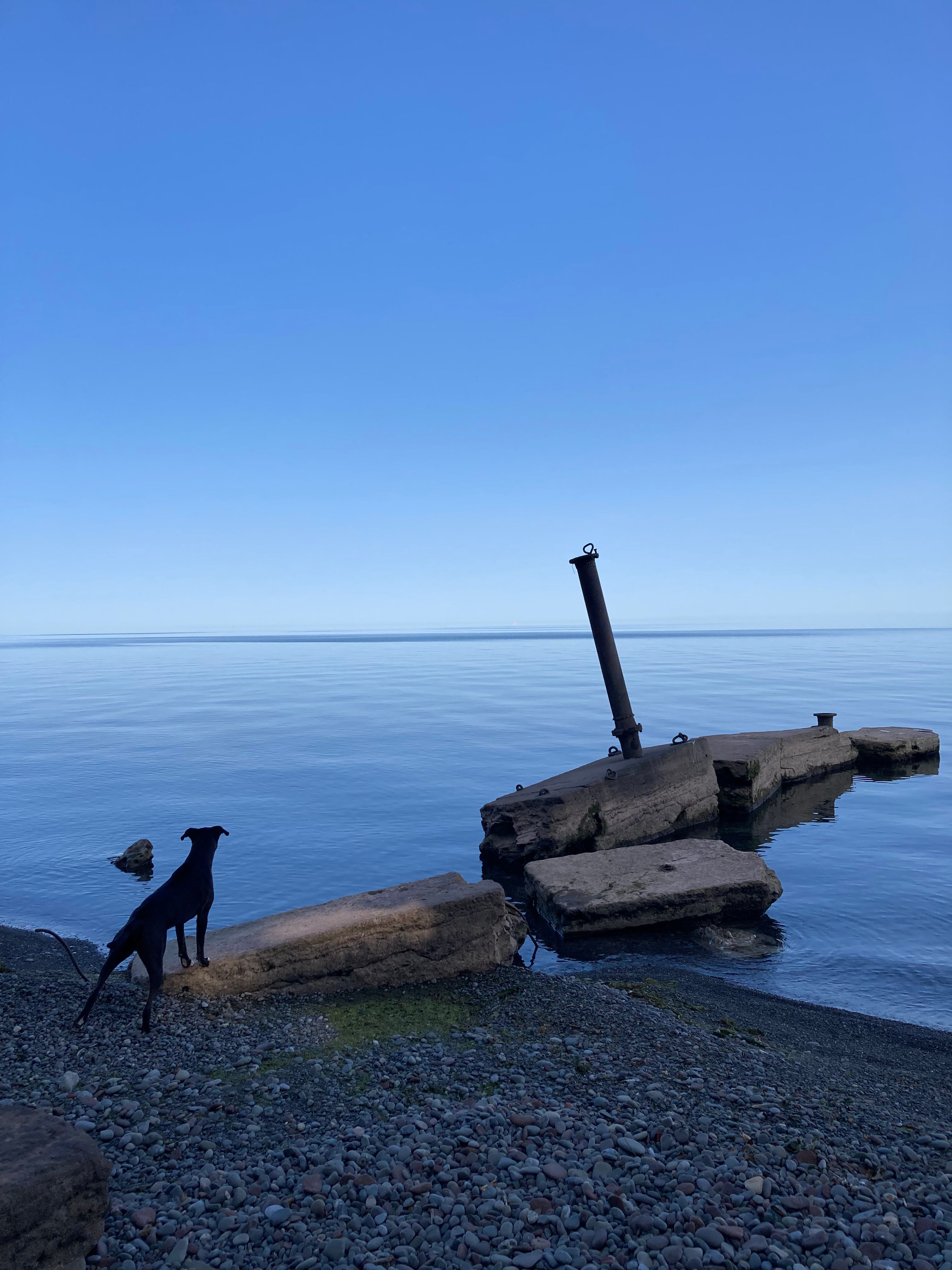
Lastly, the obligatory thematic quote:
“If all goes well, I shall disappear for some time and there will be no way to get hold of me.”
- Hermann Hesse
xoxo
Sarah
I’ve added the bit your friend said about having the perfect solution to my list of favourite quotes … really looking forward to reading your new project Sarah!
All the best wishes to your new writing project! I can't wait to read what you have in store for us. :)