


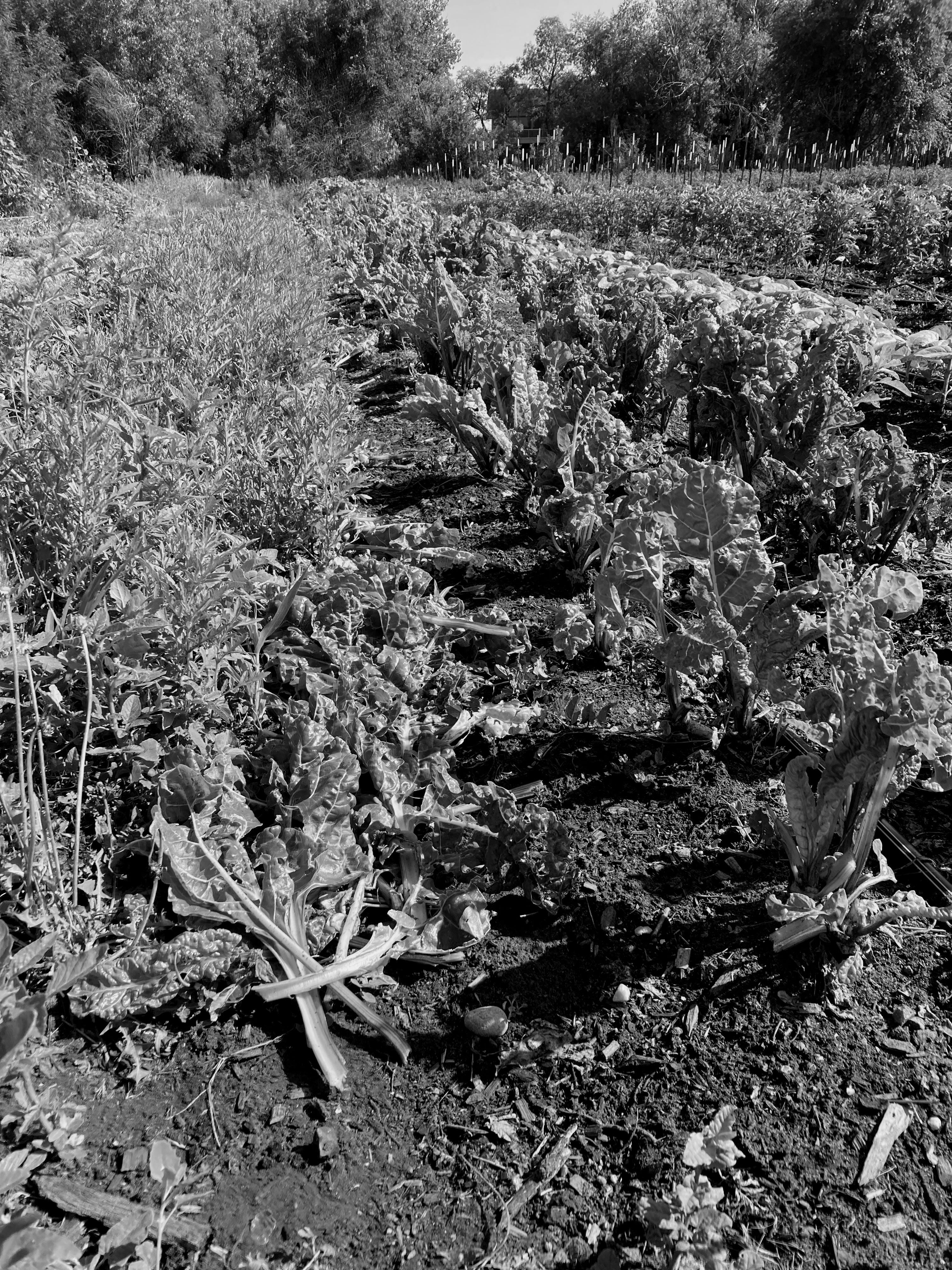
The farm where I spend three days each week is an organic one. Not officially certified - because, as you’ve probably heard some form of zeitgeist about, becoming officially certified is financially and operationally an expensive task that really only benefits the big guys. So the produce is grown with all the same principles in place, just without the shiny stamp.
I wish I could farm and still afford my life. I mean it. Being in those rows of crops, caring for the beds for hours on end, it has rewired something deep and calm in me that had halted, like the belts of salty water at the bottom of the ocean, which none of us knows much about but are responsible for nearly everything else on the planet Going Right.
I guess I’m not sure how to describe it, aside from a reunion. Like I’ve finally come home from a long journey. Not just to the farm, but to myself, to my insides, to my nervous system at a steady, happy pace. My friends tell me they’ve never seen me happier. My doctor told me I was glowing during my physical last week, right before she gave me a tetanus booster, which was a really smart call given the number of rusty irrigation clips I’ve already kneeled on.
She said I think you should keep doing this.
I sat my dirty ass on a chair covered in crinkly paper. I said sorry about the dirt all over me.
But only because we sat in a sterile, pristine, antibacterialized room. A place where the mere suggestion of visible dirt bordered on litigious. I am not really sorry.
We’ve lost something primal, I think, by not being outside most days and getting dirt under our fingernails.
All day long, I feel rivulets of sweat sliding down my inner arms and sidebody; dropping from my shoulders to the highway of my spine; beading on my upper lip and eyebrows.
At the end of my farming days, I am covered in soil, manure, sweat, sunscreen, bug spray. I have reapplied SPF at least three times in eight hours. I have sweat through my deodorant twice. There’s dirt under my fingernails, in my scalp, stuck to my chest, in between my toes. And I’ve never felt better than this. I’ve never felt more complete with a day’s worth of work than when the sheen of it still on me.
I’m no stranger to hard work, it’s just that it used to look different. Staring into cells of a spreadsheet, writing and rewriting emails, putting together a deck of slides.
But I would leave that work just as clean as I started it. All the proof of my effort, invisible. All the sweat, internalized somehow. Somewhere. Leaking down the walls of my insides. Stagnant and pooling. I couldn’t wipe it away. It remained waiting for whatever still needed to be completed tomorrow.
There is something very important about doing work with your hands; work that has an ending. Work that can be completed, physically. Where your eyeballs can see what you’ve done with the day. A 100-foot long bed, cleared of weeds. The barn and all ten stalls clean. Forty five tomato plants aligned upwards with twine. A basket full of snap peas.
The two rows of pepper plants I worked on yesterday were covered in a black rice-paper film - with holes cut every three feet for a plant to grow out of. In between those two rows was a walkway. The entire length of that walkway was covered in a lush of green - in hundreds and maybe thousands of weeds growing in whatever space they could find.
“Weed here. Get to the end. Then come find me.”
The farmer is a man of few words, and those words are mumbled. I am often not hearing him and saying “HUH?” and he is often looking at me like I am the dumbest person he’s ever had the misfortune to meet.
But this instruction made sense.
I started at one end of the bed, crawling forward on hands and knees steadily, pulling them out by the roots and piling them behind me to wilt in the sun. Clearing away a green shag carpet, and picking out the weeds that had crammed themselves into the holes that the peppers were growing out of. It took me almost two hours. I don’t usually bring my phone and earbuds with me out to the field. I get there so early that I am still nonverbal, forgetting anything besides gardening gloves, a jug of water, and to put one foot in front of the other down the dirt path.
So I listen, for two hours, to the sounds of the farm. Birds cheeping, hawks crying. Insects droning, dogs howling along to ambulance sirens in the distance. Wind in the trees. The ripping of stems, the bass of the soil releasing them, the robins chirruping to each other. And of course, my own thoughts.
It’s easier to hear them in this setting. They’re muted in color, the font is grey instead of black. And sometimes I notice that I am thinking nothing at all.
Because the farm is an organic one, we don’t use synthetic chemicals to achieve the end-results we want, which is: produce. Vegetables and herbs and flowers of all kinds to sell in CSA shares and at farmers markets and to local restaurants and at a farm stand by the side of the road.
Lots of non-organic farms use pesticides: chemicals that kill off the insects, grubs, small animals that would eat the crops that are being grown.
Lots of non-organic farms use fertilizers: chemicals that act like steroids to the soil and the plants, giving them far more than usual amounts of nitrogen and phosphorous to bulk up, all while seriously altering the soil that grows them.
Lots of non-organic farms use GMOs: seeds that have been genetically- engineered by scientists to create a test tube crop that’s highly-likely to succeed. Disease-resistant, pest-resistant, drought-resistant.
Lots of non-organic farms use herbicides: chemicals that kill off weeds that grow amongst the crops and cause them to compete for limited resources like sunshine, water, nutrients of the soil.
But because we use organic principles, we don’t add these variables to the mix. We are learning to grow and cultivate food in symbiosis and partnership with nature. The goal is that we learn how to work with the land, not make the land work for us.
And so, because the farm is an organic one, about seventy percent of our time is spent weeding. Which means seventy percent of my time is spent weeding.

I don’t have the science for this yet, but I’m learning that the days where I interact with more than just my species, life feels better. We evolved to live within a multispecies community: not just with other humans (though even this is something we are losing and losing and losing), but with regular interactions with other animals, plants, insects. We are just one in a community of living things, and we work better as just one of many pieces in a puzzle. It is lonely to be a human. Those of us with pets interact with another species a day — one other living resident of Earth — maybe two if we have the kind of dog who doesn’t chase cats.
Some fellow residents of Earth that cross my path on an average farm day include four dogs, one cat, nine horses, twelve goats (including two baby goats), twenty chickens, one dead rabbit (whom the dog caught and ate in the field, then carried around its stinking entrails until we confiscated it).
One five-foot long bull snake slithering across the path, three mice in the kitchen. A baby tiger salamander in the wood chip pile.
A Red-Tailed Hawk circling, a Cooper’s Hawk perching, two Peregrine Falcons watching the field from the posts. Robins following a few feet behind me as I weed, scavenging for the worms and grubs I’ve unearthed. Sand-pipers, shore birds that inexplicably love the farm and sprint on stick legs across its beds. A family of blue jays in the back pasture. Red-winged blackbirds cawing on the edge of the marshy wet spots. Swallows nested in the barn. Starlings in the goat pen. Goldfinches and crows and chickadees.
Spiders, beetles, rolly-polys, ants, ladybugs: an uncountable number. Scurrying to and from the leaves I weed away, hopping onto pepper plants, running under the black bed tarp for protection while I yank away bindweed and lamb’s quarters and henbit and yellow dock and Queen Anne’s Lace.
Grasshoppers. White butterflies, Miller moths. Honeybees, yellow jackets. Flies, mosquitos, horseflies. Mystery bugs I haven’t had the pleasure to be introduced to yet.
There’s a kind of belonging that comes from being immersed in this sort of community.
I am part of this.
There is also relief.
Everyone else already knows how to play their part. I just have to play mine.


To grow a plant from a seed (which is a tiny thing, and pretty darn close to growing something from nothing) - is an unbelievable amount of work. So much work that — if you were to tally the hours spent in the sun, potting and repotting, watering, pruning, flicking off beetles from leaves, fucking with irrigation, and nonstop weeding — it would seem certainly not worth it. It would seem like a horrible financial decision to make, a poor investment, a bad deal.
I think about how this must be like parenting: numbers-wise, inefficient. An unbelievable amount of work; a painful reliance on hope for the right circumstances. A 500-level course in releasing control.
I know that this is also how it feels to write. So many hours, so much protecting of those hours, so much effort to get the goddamned words onto the page - and none of it stops the eternal question from surfacing: why am I doing this?
Farming and writing are bets. Gambles. You can do everything right for months, and a hail storm in July can puncture your chard, peppers, tomatoes into pulp. You can show up each morning to your pages, and the seeds of ideas you’re tending may never germinate into the potential piece you imagined.
The Bhagavad Gita says we are only entitled to the work. Never to the rewards.
The longer I’m alive, the more I realize that building a life — growing it from nothing — requires a lot of weeding.
Your job as the farmer, the caretaker, the cultivator, is to get everything that is not the plant you want to grow out of the way. Your job is to show up, day after day, and notice what has crept in overnight. What weeds have surfaced from the Earth, and remove them. To say to them with love and care, not here or not now.
They are not enemies. They can grow somewhere else. They have the whole rest of the planet Earth to grow on, but not in this little patch of ground. Not where we are trying to create something specific. Even in the dirt, we can practice boundaries.
The fact that weeds exist is not a failure. There won’t be a time where they finally call it quits - where the Council of Weeds finally decides once and for all, to pack up and move and never grow in this row, in this bed, next to these pepper plants, ever again. Nor should they. Weeds grow and there’s not a deeper meaning to it. Weeds don’t grow because you haven’t done enough personal work, because you haven’t been to enough therapy, because you haven’t read all the right books.
An insidious thing I believed for a long time, lodged somewhere deep down, was that if I did everything right, life would always be easy, logical, or karmic. That if I simply weeded hard and long enough, I’d unearth the roots of them forever. I would conquer them. They would never come back, and I would never have to weed again - so long as I front-loaded all my efforts to eliminate them. Life would be easy, logical, and karmic.
And because I believed this, I also believed a deeper unspoken thing: that weeds only grow for those who deserve them. Misfortune, or the suffering from misfortune, comes along to those who haven’t worked hard enough. And therefore, when the weeds appeared in my life - it was a signal of my ineptitude, proof of my flaws, reminder that I was still deserving of pain and suffering. I hadn’t become enlightened yet, and I knew this because shit was still hard and things were going wrong and weeds keep popping up where I’d just removed them.
Things go wrong all the time. Things go normal all the time. And things go uncomfortable a lot of the time, too. Imperfect. Unexpected. Surprising.
Spend enough hours, months, years outside and your belief that weeds are punishing you, and you alone, will be laughed away by the happy ground. Your suspicion that a green thing could conspire against you, against anyone, baked away by the relentless sun. Please.
Weeds are not there to punish you. Weeds are there, and you are there too, and that’s that. Can you find a way to coexist? Can you find a way to get on all fours every week to greet them again; to determine anew what is and is not welcome in the soil of your days?
Growing a life you want requires weeding out what you don’t want.
But when the crop sprouts were small, it was hard to distinguish them from weeds.
The farmer said If you don’t know if it’s a weed, leave it.
It will grow, and as it grows, it will reveal itself.
This is sometimes how it goes with life, too. It’s one thing to identify someone or something toxic as soon as it arrives. To recognize the shape of leaves, the winding vine, the sea-foam green of lamb’s quarters. It’s another to not know. When you experience something new, for instance, it is not something you know - and this alone can make us uncomfortable, can make us wary, can make us believe that these feelings of not knowing are premonitions that mean we ought to just yank it out.
But it’s strategic to let it grow, because you could be wrong.
That’s why the farmer says if you don’t know, leave it. You don’t know what it will turn into. It could be a beet, after all. Or a black-eyed susan. Or a sunflower. You won’t know if you never let it reveal itself.
Many of us, myself especially, are guilty of the opposite - of not allowing what we don’t yet recognize to grow into itself. How could we know what it will become? I’ve yanked far too many potential relationships too early because I didn’t recognize their shape. (The shape I recognized, mind you, was usually unhealthy.) Instead of letting it grow, waiting and seeing, it felt safer to be certain: to be free of it. Oh well, I’d say. Better not to take the risk. Better to be sure and in control. Who knows what it could’ve become? (Obviously not me. Never me.)
Once it has some time to grow, and it starts to reveal the leggy arms of a bindweed, or the feathery triangles of lamb’s quarters, you can pull it out with a certainty you didn’t have before. There’s always time to pull it once it reveals itself to be a weed. There is always time to remove what you recognize you don’t want.
Like anything, it’s a balance. There is wisdom in the finding of moderation.
If one end of the spectrum is using herbicides to prevent weeds from ever existing in the first place, the other end is allowing them to grow uninterrupted and uninhibited.
Like being either a helicopter-tiger mom, or laissez-faire to the point of neglectful. Either a total control freak, or a complete victim. No matter your choice of strategy, there is a cost.
What is the cost of making life so seamless and easy that you never have to weed at all? Of freeing oneself of inconvenience, of engineering reward without work?
And what is the cost of having no boundaries for what is allowed to root and bloom in our lives?
I’ve never been a fan of synthetics for shortcuts. But before I actually tried farming for myself, I veered toward the “What’s wrong with letting everything grow unchecked?” side of things. Because I figured, if it grew, it should grow. Nature knows what it’s doing. Who am I to get in its way?
More nuance than this simple platitude is required. I’ve since veered again, but now to a middle ground.
The cost of unabridged allowance crystalized for me while I was clearing a row of carrots yesterday: picking everything that was left in the entire bed for this week’s market. We’d focused weeding manpower elsewhere in July, and so the row of carrots was a lush, green hedge when it should’ve been a pockmarked garden. The whole row, four feet tall now, with carrots’ delicate stems invisible among the sea of tall foxtail grass and yellowdock and thistles. After an hour on my knees, squinting for the characteristic lattice-patterned leaves, I’d only picked thirty or forty. There were close to three hundred in the row.
I could keep searching for them, spending hours wading through greenery, but that’d mean I'd forgo my time harvesting cabbage, which was ripe and ready, and given another three days would begin to wilt or be eaten by ladybugs in swiss-cheese holes. I’d have no time for pulling cherry tomatoes from the vine - now finally in their prime season and ready to be picked. And the zucchini taut and shining under leaves would keep growing faster and faster, in a few sunrises they’d double in size and be too large, too full of seeds to sell at the market.
In farming, as in life, there is a limited amount of energy, effort, and most importantly - time - that you are allotted to grow what you want to harvest. The time you spend searching for what’s valuable in a sea of unboundaried plants is time you could be spending picking ripe zucchini.
The effort required to remember, pick out, and unearth your priorities after a month of saying yes to everyone is more costly than a regular clearing away of what is not a priority.
And so the practice in farming, as in life, is finding the middle ground. Discovering how to move through the world, meeting your wants and needs, sustainably.
Remembering what, after all, you are there to grow. And removing all that is not.
When I’m on my hands and knees in the dirt, focused only on the one square foot in front of me, I think about my friends and family and every unknown person I’ve never met that I wish could be here with me, doing this too. My depressed friends, my addict friends, my anxious friends, my ADHD and ADD friends; the people who struggle to live inside the modern bubble we are acculturated to idealize. Inside the grey and white cube-apartments that take eight months to build.
I want them to farm with me. I want them to be in the dirt, too. I want them to see for themselves the lessons that the Earth has to share, has always had to share. I want them to let the work of weeding clear away some of the debris in their mind. Sweat on the outside, instead.
I want them to feel the immediate satisfaction of having a task which requires little to no thought, completing it, and being done with it. I want them to see the fruits of their labor laid out before them. The row is covered in weeds and we need them gone, and so we pull them. And then they are gone. And there is no more to the story. Nothing else to manage, to anticipate. Nothing else to judge. No invisible sweat you can’t wipe away.
I want them to do this long enough that they fall back into a low hum of existence, the quietude characteristic of our most animal selves which, these days we can only get to if we’re lucky. I want them to look up and realize it’s been twelve minutes and during that time, they haven’t reached for a phone. I want them to do a big exhale and realize how thirsty they are, and go find their water, and drink it so fast and with such gratitude that it spills down the sides of their mouth and chin. I want them to remember how wonderful it feels to want one simple, primal thing- a drink of water- instead of the four thousand shiny things that prance seductively around the modern, Western skull, which always promise this same satisfaction but never deliver.
I want them to spend a few hours on hands and knees, feeling how cool the soil is under them and how warm the sun is on their back. To thank some higher power, out loud, for a breeze. Smell the citrus of tomato plants and spiced pepper leaves, of sweet Queen Anne’s lace, of hay from the far side of the field. I want them to hear fourteen different bird and insect calls at once and be lost in the symphony. I want them to use their gloved hand to wipe the sweat from their lip and, while doing so, give themselves a dirt mustache.
I want them to pull and pull and pull and then take a big deep breath and pause for a moment, sit back on their heels, survey the weeds still to go but also look behind them, at the progress they’ve already made and I want them to feel pride. I want them to taste the precise flavor of finding a patch of Earth and sweating in silence and leaving it better than they found it. Of making life a little easier for crops to grow. Of improving a plant’s chances of growing up into the kind of being that gets to flower and bloom and make shishito peppers.
I want them to return home tired and worked, covered in dirt but clean. I want them to take a shower and have to scrub at the dirt lodged in the wrinkles of their knuckles, wipe down their knees and toes, comb out the day from their hair. Watch the brown run toward the drain.
I want them to lay on the couch at 5:30, feel the day in their legs and arms, chest and hands, heart and lungs. But not their mind.
I want them to have a long, restful night of sleep from their efforts. I want them to wake up the next morning and feel full.
I want them to feel the joy of giving, of caring for things that can never ever say thank you.
I want them to remember this is what stewardship feels like.
I want them to know that, if everything else in their lives falls apart, this ground will always be a welcoming home.
We are entitled to the work, but never the rewards.
Which means I have to find some peace in the sweating hot effort of this moment, when I sit back on my heels and realize I will be here again, two weeks from now, weeding this same row.
In another kind of career, this would have sucked the wind straight from my sails. Now though, it feels less like forcing and more like devotion.
The weeding never ends, which is possibly enough to make you want to quit or never start in the first place. This is true. But despite the weeks of the same tasks in perpetuity, the crops that I carefully pull these weeds away from still grow. A four-inch sprout of feathery tomato plants in late May reaches six feet tall in late August. The idea of cucumbers turns into small yellow flowers and tiny pimpled spears growing under umbrella leaves.
The weeding never ends, but this devotion is more than just clearing ground.
We show up again and again, ready to redo the work we did last week, forever. Not because we are gluttons for pain, but because we are creating the conditions of growth for something new. For full zucchinis warm with sunshine where before there was only soil. For cherry tomato vines overflowing with red fruit. For tall, furry sunflowers that cast precious shade while you weed along next to them.
They have grown this tall because they have been tended to. Cared for. Stewarded. Certainly, they could have grown without your help. Anything can. But isn’t there something important in knowing your existences are reciprocal?
That you have both given each other something?